
Drug repurposing provides a powerful approach to discovering new therapeutic uses for existing medications, thereby accelerating innovation while reducing development time and costs. This collection of Drug Repurposing Stories showcases successful and ongoing cases that illustrate the many paths to repurposing.
Each story offers a deeper look into the scientific, regulatory and collaborative processes that bring existing or previously developed drugs into new therapeutic applications. By revisiting what we already know, researchers can unlock fresh possibilities for patients and make biomedical research more efficient, sustainable and impactful.

We share a recent repurposing story every month on social media. These cases are then combined into a quarterly newsletter with a few more interesting cases and extra information. The first edition of the Medicines Reimagined Newsletter is coming soon!
OBINUTUZUMAB
From Cancer to Lupus
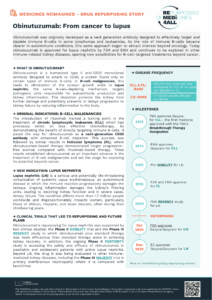 Obinutuzumab was originally developed as a next generation antibody designed to effectively target and deplete immune B-cells in some lymphomas and leukaemias. As the role of immune B-cells became clearer in autoimmune conditions, this same approach began to attract interest beyond oncology. Today obinutuzumab is approved for lupus nephritis by FDA and EMA and continues to be explored in other immune-related kidney diseases, opening new possibilities for B-cell–targeted treatments beyond cancer
References
- FDA accepts supplemental Biologics License Application for Roche’s Gazyva/Gazyvaro for the treatment of lupus nephritis. Roche Media Release. 2025. Available at: https://www.roche.com/media/releases/med-cor-2025-03-05
- FDA approves Roche’s Gazyva/Gazyvaro for the treatment of lupus nephrities; full-year earnings outlook raised. Roche Investor Update. 2025. Available at: https://www.roche.com/investors/updates/inv-update-2025-10-20
- Efficacy and Safety of Obinutuzumab in Active Lupus Nephritis. New England Journal of Medicine. 2025. doi:10.1056/NEJMoa2410965. Available at: https://www.nejm.org/doi/abs/10.1056/NEJMoa2410965
- Gazyva®: What you need to know. Lupus Foundation of America. 2025. Available at: https://www.lupus.org/resources/gazyva-what-you-need-to-know
- Obinutuzumab for the First-Line Treatment of Follicular Lymphoma. New England Journal of Medicine. 2017; 377(14):1331–1344. doi:10.1056/NEJMoa1614598. Available at: https://www.nejm.org/doi/full/10.1056/NEJMoa1614598
- FDA Approves New Genentech Medicine for Chronic Lymphocytic Leukemia (CLL). Genentech Press Release. 2026. Available at: https://www.gene.com/media/news-features/fda-approval-cll
- Zinzani PL, Muñoz J, Trotman J. Current and future therapies for follicular lymphoma. Experimental Hematology & Oncology. 2024; 13:87. doi:10.1186/s40164-024-00551-1. Available at: https://link.springer.com/article/10.1186/s40164-024-00551-1
NITISINONE
From Agrochemical to Orphan Drug
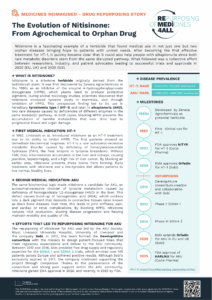 Nitisinone is a fascinating example of a herbicide that found medical use in not just one but two orphan diseases bringing hope to patients with unmet needs. After becoming the first effective treatment for HT-1, it quickly became clear that it could also help people with alkaptonuria since both rare metabolic disorders stem from the same disrupted pathway. What followed was a collective effort between researchers, industry, and patient advocates leading to successful trials and approvals in 2020 (EU, UK) and 2025 (US).
References
- Treatment of hereditary tyrosinaemia type I by inhibition of 4-hydroxyphenylpyruvate dioxygenase. The Lancet. 1992; 340:8823 p813-817. doi: 10.1016/0140-6736(92)92685-9
- Nitisinone: two decades treating hereditary tyrosinaemia type 1. The Lancet Diabetes & Endocrinology. 2021; 9:7 doi:10.1016/S2213-8587(21)00121-2.
- Evaluation of pre-symptomatic nitisinone treatment on long-term outcomes in Tyrosinemia type 1 patients: a systematic review. Orphanet Journal of Rare Diseases. 2017; 12:154. doi: 10.1186/s13023-017-0696-z.
- Inhibition of 4-hydroxyphenylpyruvate dioxygenase by 2-(2-nitro-4-trifluoromethylbenzoyl)-cyclohexane-1,3-dione and 2-(2-chloro-4-methanesulfonylbenzoyl)-cyclohexane-1,3-dione. Hum Exp Toxicol. 1996 Feb;15(2):179-81. https://doi.org/10.1006/taap.1995.1121
- Alkaptonuria: clinical manifestations and an updated approach to treatment of a rare disease. BMJ Case Reports. 2021; 14:12. doi:10.1136/bcr-2021-244240.
- ‘Never seen anything as effective’ – the not-so-new-drug repurposed for a rare disease. Horizon Magazine. Le Guillou I. 2021 Dec 30. Available at: https://projects.research-and-innovation.ec.europa.eu/en/horizon-magazine/never-seen-anything-effective-not-so-new-drug-repurposed-rare-disease
- National Library of Medicine (US), National Center for Biotechnology Information. NCBI Bookshelf Available at: https://www.ncbi.nlm.nih.gov/sites/books/NBK1454/
- Clinical Development of Nitisinone for Alkaptonuria (DevelopAKUre, Grant Agreement ID: 304985). CORDIS — European Commission. 2012–2019. Available at: https://cordis.europa.eu/project/id/304985
- DevelopAKUre Clinical Trials Programme. AKU Society. Available at: https://akusociety.org/developakure/
- Cycle Pharmaceuticals. HARLIKU™ (nitisinone) launch. Press release. 2025. Available at: https://cyclepharma.com/news/harliku-nitisinone-tablets-launch/
- Orfadin (nitisinone). European Medicines Agency. EPAR — Product Information. Available at: https://www.ema.europa.eu/en/documents/product-information/orfadin-epar-product-information_en.pdf
SOTATERCEPT (WINREVAIR)
From blood disorders to pulmonary hypertension
Sotatercept is a recombinant fusion protein that traps activin ligands to rebalance signalling pathways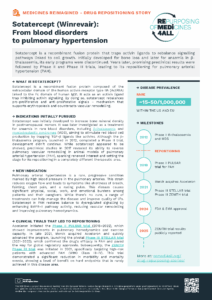 linked to cell growth. Initially developed for bone loss and later for anaemia in β-thalassemia, its early programs were discontinued.
Years later, promising preclinical results were followed by Phase II and Phase III trials, leading to its repositioning for pulmonary arterial hypertension (PAH).
References
- Sotatercept for the treatment of pulmonary arterial hypertension. New England Journal of Medicine. 2021; 384(13):1204–1215. doi: 10.1056/NEJMoa2024277.
- Sotatercept increases bone formation and bone mass in postmenopausal women with low bone mass. Journal of Bone and Mineral Research. 2009; 24(4): 744–752. doi.org/10.1359/jbmr.081208
- Acceleron announces preclinical results in pulmonary arterial hypertension at the American Heart Association 2017 Scientific Sessions. BioSpace. Published November 14, 2017. Available at: https://www.biospace.com/acceleron-announces-preclinical-results-in-pulmonary-arterial-hypertension-at-the-american-heart-association-2017-scientific-sessions
- Pulmonary arterial hypertension. Genetic and Rare Diseases Information Center (GARD), National Center for Advancing Translational Sciences (NCATS), National Institutes of Health (NIH). Available at: https://rarediseases.info.nih.gov/diseases/7501/pulmonary-arterial-hypertension
- Merck completes acquisition of Acceleron Pharma Inc. Merck & Co., Inc. Published November 22, 2021. Available at: https://www.merck.com/news/merck-completes-acquisition-of-acceleron-pharma-inc/
- Pulmonary arterial hypertension: Updates in epidemiology and evaluation of patients. The American Journal of Managed Care (AJMC). Published March 12, 2021. Available at: https://www.ajmc.com/view/pulmonary-arterial-hypertension-updates-in-epidemiology-and-evaluation-of-patients
- Pulmonary arterial hypertension. Orphanet. Orpha code: 422. Available at: https://www.orpha.net/en/disease/detail/422
- Pulmonary arterial hypertension. Genetic and Rare Diseases Information Center (GARD), National Center for Advancing Translational Sciences (NCATS), National Institutes of Health (NIH). Available at: https://rarediseases.info.nih.gov/diseases/7501/pulmonary-arterial-hypertension
REMEDi4ALL Partners & Associated partners